Halftone poster maker

Turn a photo into a wall of printed dots.

Choose a fine, medium, or bold halftone, preview the poster grid, and download the result across A4 or US Letter sheets.

Start with your file

Free to use. Your finished PDF is yours to print and keep.

Mountain photograph ready to convert into a large black and white halftone poster
High-contrast photos make the clearest halftone posters.
1

Choose your artwork

JPG, PNG, WebP, or one-page PDF

2

Set the poster size

Use pages or a real finished size

3

Choose the crop

Fit keeps everything. Fill trims edges.

4

Choose the finish

Keep the image original or turn it into printed dots.

Printer setup

PageToPoster does not store your file

Print preview

Drop your artwork here

See every page before you print.

Up to 20 MB
Clear print setup

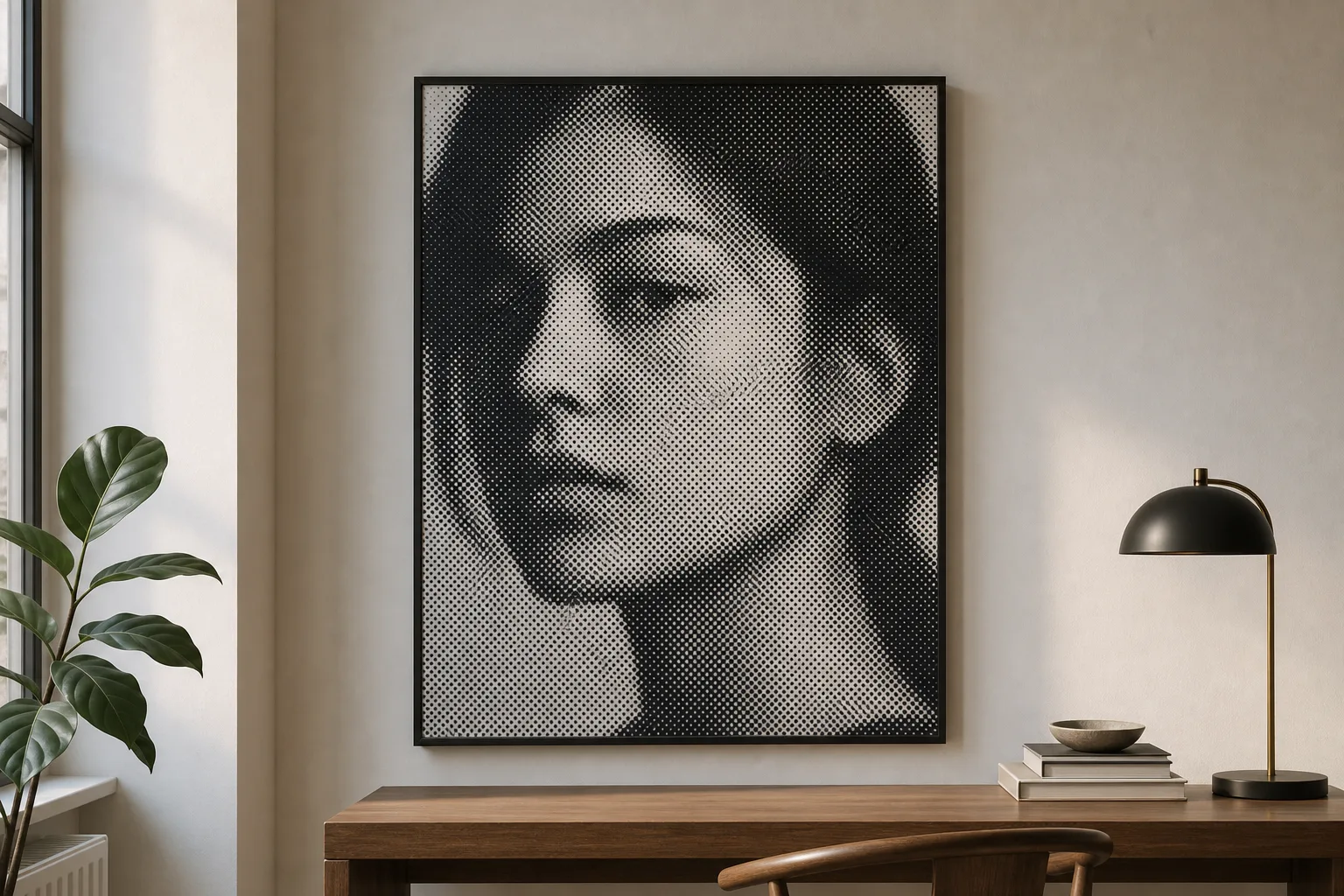
The dots grow in dark areas and disappear into highlights.

Halftone printing recreates shades with different sizes of black dots. From across the room the eye blends those dots into a photograph; up close the printed pattern becomes part of the design.

Fine dots hold more detail but need a sharper source and reliable printer. Bold dots simplify the image and work well for oversized wall art, event backdrops, and graphic portraits.

The halftone is applied to the downloaded PDF. Keep the poster preview open while you choose the grid, then use the first printed page to judge whether the selected dot size suits the viewing distance.

Before you print

Settings that matter for this job.

  1. Start with visible light and dark areas.

    Portraits, architecture, and simple landscapes usually translate better than low-contrast or very busy photos.

  2. Choose dots for the viewing distance.

    Use fine dots for close viewing and bold dots when the poster will be seen from several feet away.

  3. Test one sheet before the full run.

    Print the first page at Actual size to check dot definition and ink coverage before using the rest of the paper.

FAQ

Questions about this print job.

What is a halftone poster?

A halftone poster uses black dots of different sizes to reproduce light and dark tones. The dots are visible up close and blend into an image from farther away.

Which photos work best for halftone printing?

Images with a clear subject, strong contrast, and broad shapes work best. Very dark photos and images filled with tiny details may need editing before conversion.

Should I use fine or bold dots?

Choose fine dots for more detail and closer viewing. Choose bold dots for a more graphic result or a poster viewed from farther away.

Does the downloaded PDF include the halftone effect?

Yes. PageToPoster applies the selected dot pattern to every sheet in the exported PDF.

Print it right the first time.

Does PageToPoster store my image?

PageToPoster does not store your image or PDF.

Which print setting should I use?

Choose Actual size or 100% in the print dialog. Turn off Fit, Shrink, and Scale to page so every sheet keeps its intended dimensions.

Why do the pages overlap?

A small repeated edge makes alignment easier. Trim the marked edge of one sheet, place it over the matching image on the next sheet, then tape from behind.

Will this work with a home printer?

Yes. The default safe margin works with common inkjet and laser printers. Use the free printer scaling test if exact physical size matters.

What image quality do I need?

The live preview estimates effective image DPI. Above 150 DPI is crisp at close range. Lower values can still work for wall posters viewed from a few feet away.